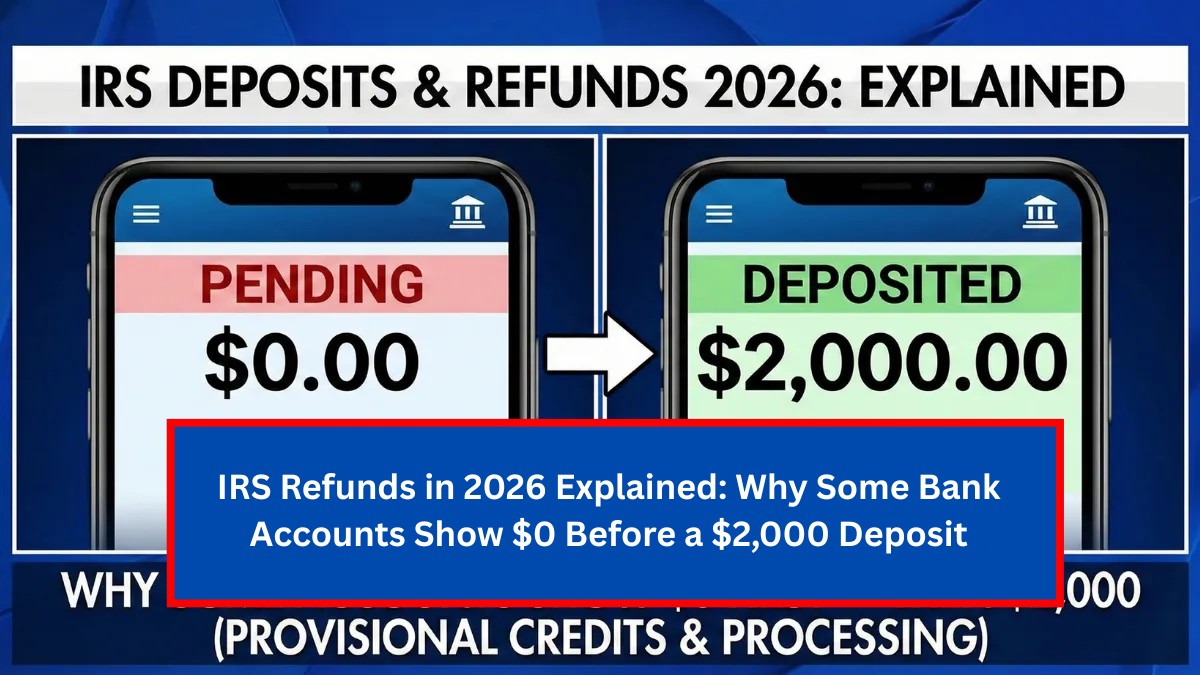
During the 2026 tax season, many taxpayers are noticing a confusing pattern in their bank accounts. An IRS-related transaction briefly appears as $0, only to update later with a $2,000 deposit. This has caused concern about failed refunds or canceled payments. In most cases, however, this sequence is completely normal and part of standard federal payment processing.
This article explains why the $0 entry appears, how IRS refund systems work, and what taxpayers should know while tracking their refunds.
Why IRS Deposits Sometimes Appear as $0 First
A temporary $0 entry is usually a pre-authorization or placeholder transaction created by banks or payment processors. When the IRS schedules a refund, the bank may first verify the incoming payment before crediting the actual amount.
This placeholder does not mean the refund was denied, reversed, or canceled.
Common meanings of refund status updates
- $0 pending entry – Bank verification or pre-authorization
- Refund approved by IRS – Funds released by the IRS
- Processing delay – Bank posting timeline
- Final deposit appears – Refund fully credited
- Typical timeline – 1 to 3 business days
How IRS Refund Processing Works in 2026
Once the IRS approves a refund, it sends payment instructions through the federal banking network. At this stage, the IRS’s role is complete. From there, banks handle validation, security checks, and posting of the deposit.
Some banks show a temporary $0 transaction while these checks are completed. After verification, the full refund amount is credited to the account.
Why $2,000 Refunds Are More Likely to Show This Issue
Refunds around $2,000 often include refundable tax credits or withholding adjustments. These refunds typically go through additional verification steps, which can slow posting time.
Because of this extra review, banks are more likely to display a placeholder transaction before releasing the funds.
IRS Approval vs Bank Posting Explained
An IRS-approved refund does not mean the money will appear instantly. The IRS releases the payment, but banks control when and how the deposit is posted. This includes whether a temporary $0 entry appears before the final amount.
The delay usually comes from the bank, not the IRS.
Does a $0 Entry Mean There Is a Problem
In most cases, no. A $0 entry simply means the bank has received the deposit instructions but has not completed processing.
Action is only recommended if:
- The $0 entry remains for more than five business days
- There is no update to the refund amount
- The IRS status shows “issued” but no funds arrive
What Taxpayers Should Do
- Monitor the IRS Where’s My Refund tool
- Check your bank account regularly
- Avoid filing amended returns too quickly
- Do not assume a problem without an official notice
Most refunds resolve automatically within a few days.
When to Contact the IRS or Your Bank
- Contact your bank if the $0 entry does not update after several business days
- Contact the IRS only if the refund shows “sent” or “issued” and no deposit appears after the full processing window
Key Facts to Remember
- $0 entries are usually temporary
- Banks control final deposit posting
- $2,000 refunds often face extra verification
- Most delays resolve on their own
- A delay does not mean cancellation
Conclusion
Seeing a $0 transaction followed by a $2,000 deposit during the 2026 tax season is typically part of normal IRS-to-bank processing. Understanding the difference between IRS approval and bank posting can help reduce stress and prevent unnecessary follow-ups while waiting for your refund.
Disclaimer
This article is for informational purposes only and does not constitute tax or financial advice. IRS refund timing and bank posting practices vary by individual circumstances and financial institutions. Always rely on official IRS tools or your bank for confirmation.